What is speaker diarization? How AI separates voices in a recording
A plain-English explainer on how AI figures out "who spoke when" in an audio recording, where it succeeds, and when it falls apart.
Published · Updated · 1123 words · 6 min read · By Prashant
I once read a 45-minute interview transcript with no speaker labels. The raw text told me what was said. It did not tell me who said it. The interviewer's questions and the subject's answers ran together like one person arguing with themselves. The transcript was technically accurate and completely useless.
This is the problem speaker diarization exists to solve. The fancy term hides a simple question: who spoke when?
Quick answer: Speaker diarization answers "who spoke when." It uses voice activity detection, speaker embeddings, and clustering to group speech by voice. It does not know names. It struggles with overlapping speech, similar voices, and background noise.
What diarization actually does
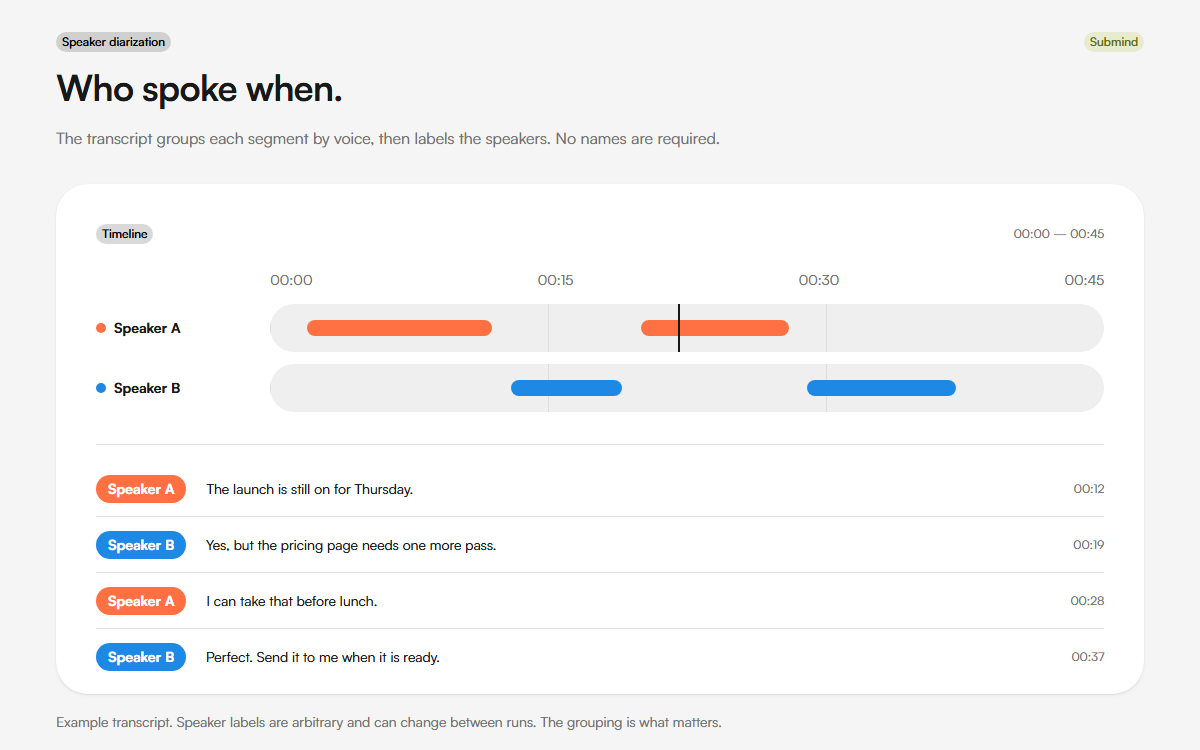
Diarization takes an audio file with multiple voices and labels each segment with a speaker identity. Not their name. Not their email address. Just "this chunk of speech came from Speaker A, this next chunk came from Speaker B."
It does not know Speaker A is named Priya or that Speaker B has a Scottish accent. It just knows they sound different. The labels are arbitrary. If you run diarization on the same file twice, the person labeled Speaker A the first time might be Speaker B the second time. The important thing is that the segments are grouped correctly.
How it works under the hood
The process has three stages. None of them involve the AI understanding what anyone is saying.
First, voice activity detection. The system figures out which parts of the audio contain human speech and which parts are silence or noise. This sounds trivial. It is not. A door slam can look a lot like a plosive consonant to a model that only sees waveforms.
Second, speaker embedding. The system chops the speech segments into small slices and converts each slice into a mathematical representation called an embedding. Think of an embedding as a coordinate in a high-dimensional space where voices that sound similar sit close together. If two slices produce embeddings near each other, they probably came from the same speaker. The magic is in how these embeddings are trained. Modern systems use neural networks that learned to distinguish speakers from millions of labeled examples.
Third, clustering. The system groups the embeddings into speaker clusters using algorithms like spectral clustering or agglomerative hierarchical clustering. Each cluster gets a label: Speaker A, Speaker B, and so on. The hard part is knowing how many clusters to make. The system does not know in advance that your recording has three speakers. It has to guess based on how the embeddings naturally group. Open-source toolkits such as pyannote package these stages for you.
Where it goes wrong
Overlapping speech is the biggest problem. If two people talk at the same time, the embedding for that slice is a blend of both voices. It does not cleanly match any single speaker. The system either assigns it to whoever is louder or splits it into nonsense segments.
Similar-sounding voices break the clustering step. Two women with similar pitch ranges, or two men with similar cadences. The embeddings sit close together in that high-dimensional space. The clustering algorithm cannot tell them apart. It merges them into one speaker or splits one speaker into two.
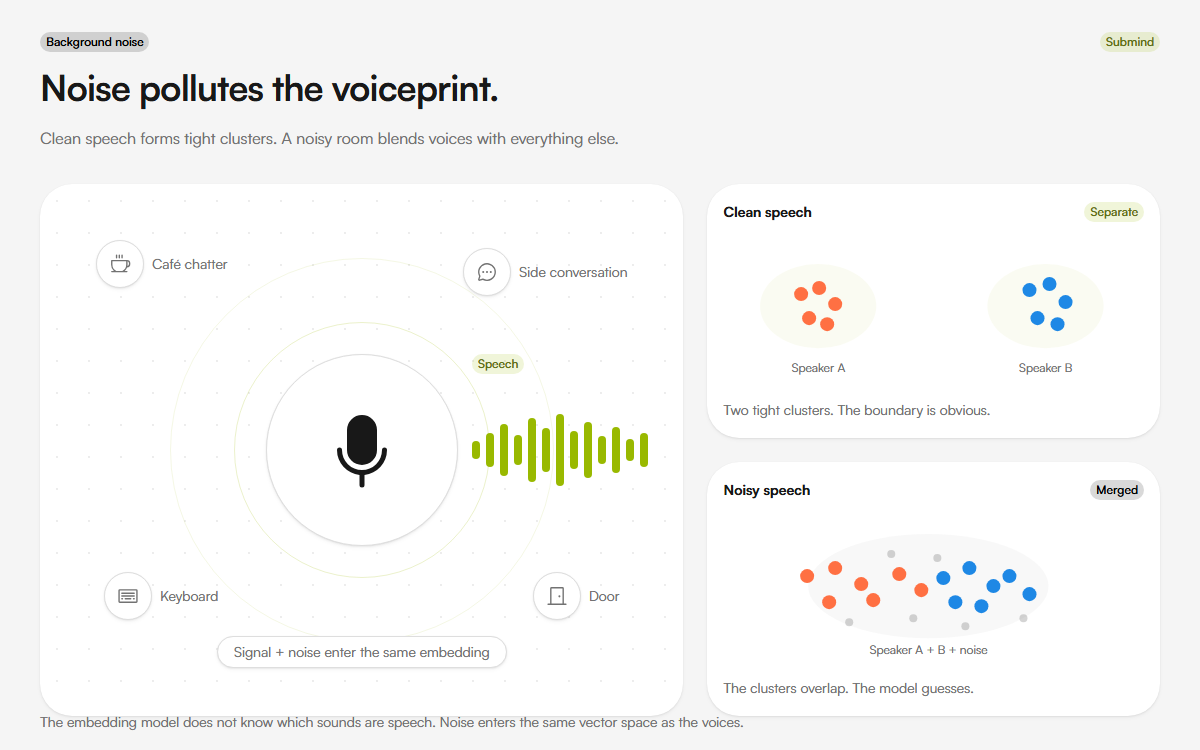
Background noise degrades everything. The voice activity detector mistakes noise for speech. The embeddings get polluted with non-speech information. A recording made in a coffee shop will produce worse diarization than the same conversation recorded in a quiet room. This is true regardless of which engine you use.
Short utterances make clustering unreliable. If a speaker says three words then goes silent for ten minutes, the system has almost nothing to build an embedding from. That speaker might get merged into someone else entirely.
The old way vs. the new way
Until about 2019, most diarization systems used what researchers now call the "clustering pipeline." You extract speaker embeddings with a model like an x-vector extractor, then you run a clustering algorithm on top. The two stages are separate. The clustering algorithm has no idea what the embedding model was trying to do.
Newer systems use end-to-end neural diarization. The model learns to do embedding and clustering together, jointly optimized. Google's UIS-RNN was an early example. More recent approaches like EEND (End-to-End Neural Diarization) and DiaPer push this further. They can handle overlapping speech better and do not need a separate clustering step.
The tradeoff is that end-to-end models need more training data and are harder to debug. With a clustering pipeline, you can look at the embeddings and see why two speakers got merged. With an end-to-end model, you get a result and you trust it.
Why it matters
Nobody listens to meeting recordings anymore. They read the transcript. And a transcript without speaker labels is barely better than the raw audio. You still have to do the mental work of separating who said what.
For podcasts, diarization makes transcripts readable. For call centers, it enables conversation analytics: how much did the customer talk versus the agent? For journalists, it turns an interview recording into a searchable document where quotes are attributed to the right person. For legal proceedings, it creates an accurate record of testimony.
The technology is not perfect. But imperfect speaker labels are better than no speaker labels. And unlike five years ago, you do not need a PhD in signal processing to use it.
You can see how transcripts look without speaker labels in the free audio to text tool. The main app adds speaker identification on top of transcription, and the Submind AI page explains how it fits.
Related reading
Sources
FAQ
What is speaker diarization?
It is the process of labeling which speaker said which part of an audio recording. It answers "who spoke when," not "what did they say."
Does diarization identify people by name?
No. It assigns labels such as Speaker A and Speaker B. Mapping those labels to real names requires speaker recognition or manual review.
Why does overlapping speech break diarization?
Two voices at once create a mixed embedding. It does not match either speaker cleanly, so the system merges the segment or splits it into nonsense.
Is diarization the same as transcription?
No. Transcription turns speech into text. Diarization adds speaker labels to that text. You can use either one without the other.
About the author
Prashant is the founder of Submind. He writes about voice notes, transcription, and turning spoken thoughts into structured notes.
Read the full story