OpenAI Whisper vs Deepgram vs AssemblyAI: which transcription API is most accurate?
A developer-focused comparison of three major transcription APIs. Accuracy, latency, pricing, and features. No marketing fluff.
Published · Updated · 1520 words · 8 min read · By Prashant
I needed to add transcription to a project last month. Nothing fancy. Ingest audio, return text, move on. I assumed this would take an afternoon. It took three days.
The problem was not the code. The problem was choosing between the APIs. Every provider publishes benchmarks. None of them match real-world audio. Here is what I learned after testing the three biggest options with actual recordings.
Model names and prices were checked in October 2026. They change often, so use the provider links below before you commit.
Quick answer: Choose Deepgram for real-time streaming. Choose AssemblyAI for transcript intelligence such as diarization, PII redaction, and entity detection. Choose Whisper for broad language coverage or self-hosting. Test all three on your own audio before you commit.
Three very different approaches
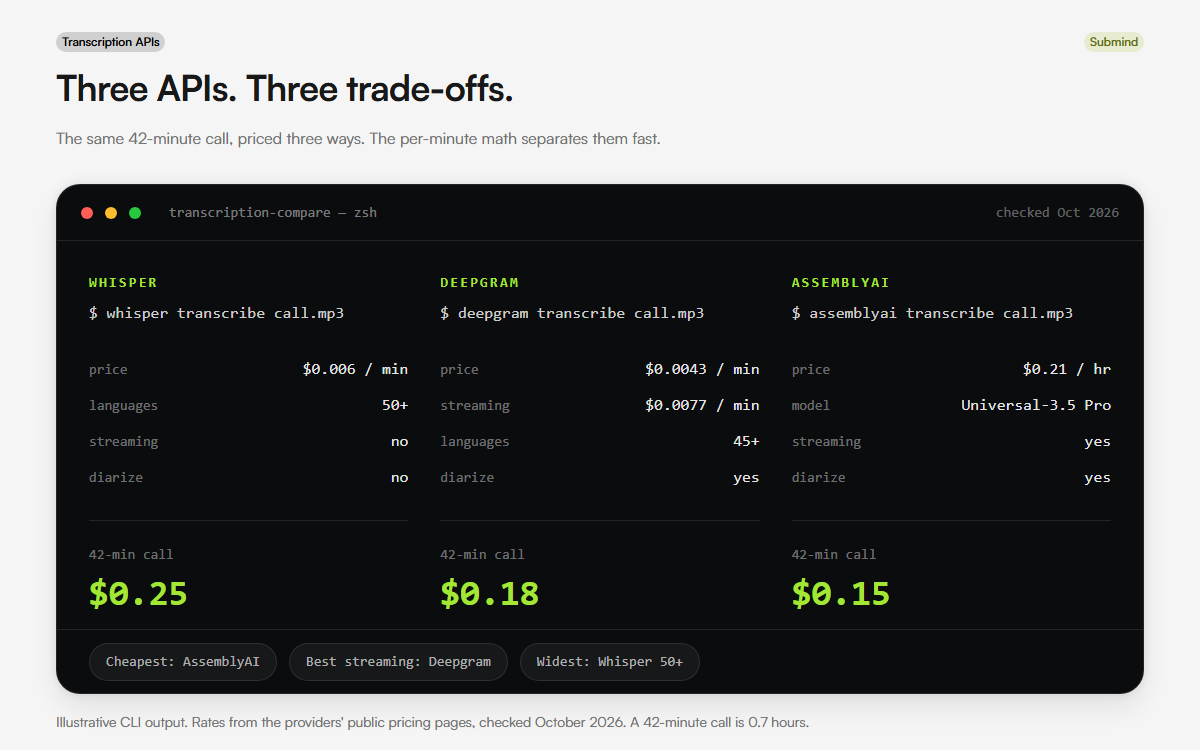
OpenAI Whisper is an open-source model. You can run it on your own hardware for free, or call it through OpenAI's API at $0.006 per minute, according to OpenAI's API pricing. It was trained on 680,000 hours of multilingual audio scraped from the web. There are six model sizes ranging from tiny (39 million parameters, about 1 GB of VRAM) to large (1.55 billion parameters, about 10 GB of VRAM). The turbo variant trimmed the large model to 809 million parameters and made it about eight times faster with minimal accuracy loss. Whisper does transcription and translation. That is it. No speaker diarization. No word-level timestamps. No sentiment analysis. It handles 50 plus languages well and is unusually robust to accents compared to older models. The API does not support real-time streaming. You upload a file, you wait, you get text back. The maximum file size is 25 MB.
Deepgram is a specialized speech recognition company. Its Nova-3 model is the current default for most work. Deepgram reports a 5.26 percent word error rate on batch transcription, measured on its own evaluation set. Pre-recorded Nova-3 costs $0.0043 per minute. Streaming Nova-3 costs $0.0077 per minute at the regular rate, with a current promotional rate of $0.0048 per minute, according to Deepgram's pricing page. Deepgram supports streaming natively. It also offers speaker diarization, smart formatting, word-level timestamps, profanity filtering, and keyword boosting. The Flux model is built for voice agents with end-of-turn detection. Language support is narrower than Whisper. Deepgram says its Nova models cover 45+ languages, focused on the most commonly used ones.
AssemblyAI is the feature-heavy option. Its current pre-recorded line is Universal-3.5 Pro at $0.21 per hour. Universal-2 is still available at $0.15 per hour, according to AssemblyAI's pricing page. The older Universal-2 model reported a 10.7 percent word error rate, which was higher than Deepgram and Whisper on pure transcription accuracy. AssemblyAI's pitch is that it optimizes for "immediately usable data." Its formatting for phone numbers, dates, and product codes is better than competitors, and it offers a wide feature set: speaker diarization, sentiment analysis, entity detection, PII redaction, content moderation, chapter detection, and custom vocabulary. Some of those are add-ons. SLAM-1 is deprecated, so do not start a new integration on it. AssemblyAI now has Universal-3.6 Pro Realtime and Universal-Streaming models for real-time work.
The accuracy numbers are slippery
Every provider publishes word error rate benchmarks. Do not trust any of them blindly.
Whisper's published benchmarks look great on LibriSpeech, a dataset of audiobook readings in quiet conditions. On noisy real-world audio with fast speech and overlapping voices, the error rate climbs. A lot.
Deepgram's 5.26 percent WER is impressive, but it was measured on their evaluation dataset. Your audio with your microphone in your environment will produce different numbers. Deepgram themselves recommend running custom evaluations with your own audio files.
AssemblyAI's older Universal-2 model reported a 10.7 percent WER. That looks worse on paper. But they measure differently and optimize for different things. AssemblyAI says its alphanumeric accuracy for phone numbers and IDs is 21 percent better than its previous model. If your transcript needs to get a customer's phone number right, that matters more than the headline WER.
The only useful benchmark is your own benchmark. Take ten representative audio files from your actual use case. Run them through all three APIs. Count the errors yourself. Every other number is marketing.
Latency: the real differentiator
If you need real-time transcription, your options narrow fast. Deepgram supports it natively with low latency. AssemblyAI now has Universal-3.6 Pro Realtime and Universal-Streaming models for real-time work. Whisper does not support it through the API at all. OpenAI has a separate Realtime API, but it is a different product with different pricing and a different integration path.
For batch transcription, all three work fine. Whisper's turbo model is fast. Deepgram's batch mode is fast. AssemblyAI is comparable. The differences are in seconds, not minutes.
If you run Whisper locally on your own GPU, latency depends entirely on your hardware. The large model on a consumer GPU might take twice as long as the audio duration. The tiny model might run ten times faster than real-time. You trade accuracy for speed.
Features beyond transcription
Whisper gives you text. That is it. No diarization. No timestamps at the word level. No formatting beyond basic punctuation. If you need speaker labels, you have to add a separate diarization model like pyannote. If you need word-level timestamps, you need to implement that yourself. This is fine for many projects. It is not fine if you are building a meeting transcript product.
Deepgram gives you diarization, smart formatting, timestamps, profanity filtering, and keyword boosting. These are included in the API price, not add-ons.
AssemblyAI gives you the most: diarization, sentiment analysis, entity detection, PII redaction, content moderation, chapters, and custom vocabulary. If you are building a product that needs transcript intelligence, not just transcription, this stack saves you from wiring together multiple services.
Pricing, with actual math
At 100 hours of audio per month:
- Whisper API: 100 hours at $0.006 per minute is $36. Self-hosting on your own GPU is free beyond infrastructure costs.
- Deepgram batch: 100 hours at $0.0043 per minute is $25.80.
- Deepgram streaming: 100 hours at the regular $0.0077 per minute is $46.20. At the current $0.0048 promotional rate, it is $28.80.
- AssemblyAI Universal-3.5 Pro: 100 hours at $0.21 per hour is $21.00. Universal-2 at $0.15 per hour is $15.00.
At 1,000 hours per month, volume discounts kick in differently for each provider. Deepgram and AssemblyAI offer enterprise pricing. Whisper self-hosted gets more attractive as volume increases because your GPU cost stays roughly flat while API costs scale linearly.
Which one for which project
If you are a solo developer building a side project and you own a GPU, start with self-hosted Whisper. It is free, it is good enough, and you can switch later when you have paying users.
If you need real-time transcription, pick Deepgram. It is the most mature streaming option. The latency is low and the accuracy holds up under real-time conditions.
If you need transcript intelligence features like sentiment analysis, entity extraction, or PII redaction, pick AssemblyAI. The formatting quality and the feature set are the reason to pick it. Test the current model on your own audio before you commit.
If you need the broadest language coverage, Whisper is the widest. Deepgram covers 45+ languages, and AssemblyAI covers the most widely spoken ones.
None of these APIs is the wrong choice. The wrong choice is picking one without testing your own audio first.
One more option is worth testing before you pay for an API. For short, single-file, seven-language work, you can run transcription in the browser. Submind's free audio to text tool and voice recorder run an open-source on-device model in WebAssembly with no server and no upload. The live transcription tool runs the same model on a microphone stream. There is no per-minute pricing line. Server APIs still win on language breadth, volume, and latency-critical streaming. For a single recording, the browser is a real option.
Related reading
Sources
FAQ
Which transcription API is most accurate?
There is no universal winner. Deepgram reports 5.26 percent word error rate on its own evaluation set. AssemblyAI formats numbers and IDs well. Whisper is robust across accents. Test on your own audio.
Which API is cheapest?
AssemblyAI Universal-2 is $0.15 per hour. Deepgram batch is $0.0043 per minute, or about $0.26 per hour. Whisper API is $0.006 per minute, or $0.36 per hour. Self-hosted Whisper is free beyond your hardware cost.
Which API supports real-time streaming?
Deepgram supports streaming natively. AssemblyAI has separate realtime models. Whisper does not support streaming through its API.
Can Whisper do speaker diarization?
No. Whisper returns text. You need a separate diarization model such as pyannote if you want speaker labels.
About the author
Prashant is the founder of Submind. He writes about voice notes, transcription, and turning spoken thoughts into structured notes.
Read the full story